How to Write a Blog Post Faster with AI: A Step-by-Step Guide
Learn how to leverage AI to accelerate your blog writing process, from brainstorming ideas to polishing your final draft. This guide breaks down the steps to create compelling content more efficiently.
9 min read · September 4, 2026

You know you need to publish blog content regularly to attract and engage your audience, but finding the time, generating fresh ideas, and overcoming writer's block are constant challenges. This leads to inconsistent publishing schedules and missed opportunities. If you're a blogger, content creator, or small business owner looking to increase your content output without sacrificing quality, AI can be a powerful ally.
This guide will walk you through a step-by-step workflow for using AI to accelerate every stage of your blog post creation, from initial brainstorming to final SEO optimization. We'll focus on how an integrated platform can streamline this process, replacing the need for multiple separate tools.
Understanding AI's Role in Blog Writing
Artificial intelligence can assist at numerous points in the content creation pipeline. It's not just about generating text; AI can help you discover what to write about, structure your thoughts, refine your prose, and even prepare your content for search engines.
The benefits of using AI for blog writing are substantial:
- Increased Efficiency: AI can significantly reduce the time spent on research, drafting, and editing.
- Overcoming Writer's Block: AI provides prompts and initial drafts to get your creative juices flowing.
- Enhanced Idea Generation: AI can uncover trending topics and niche ideas you might not have considered.
- Improved Content Quality: AI tools can help refine grammar, style, and clarity, leading to more polished articles.
- SEO Assistance: AI can offer suggestions for keyword integration and meta descriptions.
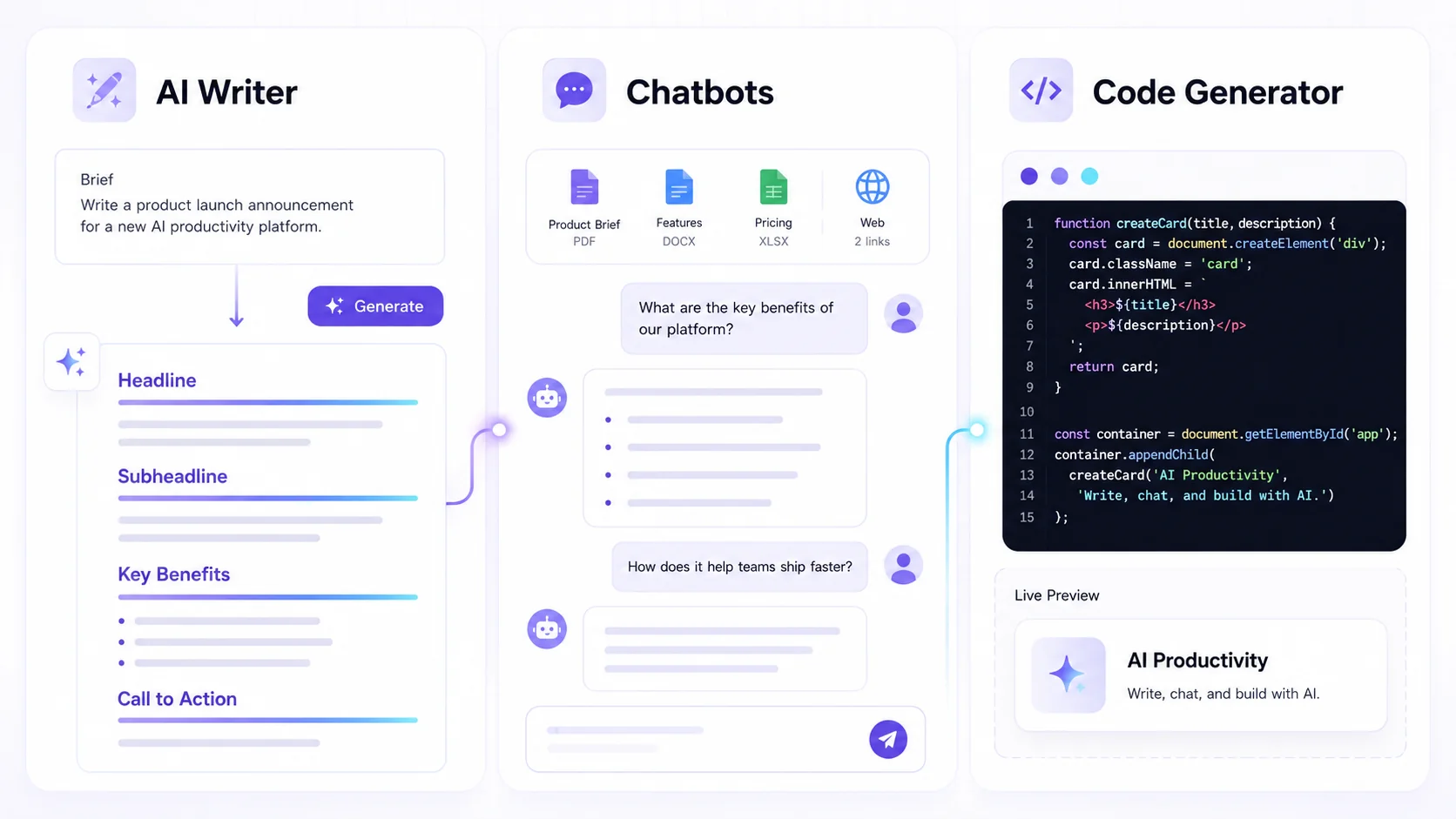
Instead of subscribing to several different AI tools for writing, voiceovers, image generation, and more, an all-in-one AI creative studio consolidates these capabilities into a single interface. This unified approach simplifies your workflow, reduces costs, and ensures consistency across your content creation process. Tools like the AI Writer and Article Wizard are designed to handle various writing tasks, making them central to an efficient blogging strategy.
Step 1: Brainstorming Blog Post Ideas with AI
The foundation of any great blog post is a compelling idea. AI can transform this initial stage from a daunting task into an exciting exploration.
Generating Topic Ideas: Start by feeding your niche or general subject area into an AI writing tool. Ask for a list of blog post ideas, trending topics, or common questions within that field. For instance, if you're in the sustainable fashion niche, you could prompt: "Generate 20 blog post ideas about sustainable fashion for Gen Z consumers."
Keyword Research: While not a dedicated SEO tool, many AI writers can help identify relevant keywords. You can ask the AI to suggest keywords related to a specific topic or to analyze a competitor's article (if you provide the text) and identify key terms. This initial keyword exploration can guide your topic selection.
Identifying Trending Subjects: AI can also analyze current trends. By asking questions like "What are the latest discussions around remote work productivity?" or "What are popular health and wellness topics right now?", you can tap into what audiences are currently interested in. This is crucial for staying relevant and attracting readers searching for timely information.
If you find yourself stuck, remember that AI is an excellent resource to beat writer's block. By generating a variety of prompts and angles, AI can quickly provide starting points that spark your own creativity.
Step 2: Outlining Your Blog Post with AI Assistance
Once you have a solid topic, the next step is to create a logical structure. A well-organized outline ensures your post flows coherently and covers all necessary points without becoming rambling.
Structuring Your Content: AI can help you break down your chosen topic into manageable sections. You can ask an AI writer to "Create an outline for a blog post about [your topic]," specifying any key points you want to include. The AI will generate a hierarchical structure with main headings and subheadings.
Ensuring Coherent Flow: Review the AI-generated outline. Does it make sense? Is there a logical progression from one point to the next? You can refine this outline by rearranging sections, adding new sub-points, or asking the AI to elaborate on specific areas. For example, if the AI suggests a section on "Benefits," you might ask it to "Expand on the benefits of [your topic] with three distinct sub-points."
Developing Logical Headings: The headings and subheadings are crucial for readability and SEO. AI can suggest compelling and keyword-rich headings that accurately reflect the content of each section. This not only helps readers navigate the post but also signals to search engines what your content is about.
Step 3: Drafting Your Content with an AI Writer
With a clear outline in hand, it's time to generate the initial draft. This is where AI writers truly shine, transforming your outline into readable prose.
Effective Prompting: The quality of your AI-generated draft depends heavily on your prompts. Be as specific as possible. Instead of a generic "write about X," provide context. Include:
- The Topic: Clearly state what the blog post is about.
- The Outline: Provide the structure you developed in Step 2.
- Target Audience: Who are you writing for? (e.g., beginners, experts, small business owners).
- Tone of Voice: (e.g., professional, casual, informative, humorous).
- Key Information/Data: Any specific facts or statistics you want included.
- Desired Length: An approximate word count or paragraph count for sections.
Generating Initial Drafts: You can prompt the AI to write an entire section based on a heading and its sub-points, or even the whole post if your outline is detailed enough. For instance: "Write the introduction for a blog post titled '[Your Title]' targeting small business owners. Explain the challenges of consistent content creation and introduce AI as a solution. Maintain a professional yet encouraging tone."
Expanding on Ideas: If the AI generates a brief paragraph or sentence that captures a good idea, you can ask it to expand. "Expand on this point: 'AI can help streamline SEO tasks.'" The AI will then generate more detailed content around that specific idea.
Maintaining Consistency: When generating content section by section, ensure you remind the AI of the overall tone and goal of the article. This helps maintain a consistent voice and message throughout the draft.
Step 4: Refining and Enhancing Your Draft with AI Tools
The initial AI-generated draft is rarely perfect. It serves as a strong foundation, but human editing and further AI assistance are key to polishing it into a high-quality piece.
Rephrasing and Summarizing: AI tools like the Smart Editor can help rephrase sentences or paragraphs that sound awkward or repetitive. You can highlight a section and ask the AI to "rephrase this for clarity" or "summarize this paragraph into a single sentence." This is invaluable for improving flow and conciseness.
Improving Clarity and Grammar: Beyond basic spell-checking, AI can analyze your text for grammatical errors, punctuation mistakes, and stylistic inconsistencies. It can suggest alternative word choices to enhance vocabulary and improve overall readability.
Integrating AI-Generated Images: Visuals are essential for breaking up text and engaging readers. Once your content is drafted and refined, you can use an AI Image generator to create custom graphics. Based on your blog post's topic or specific sections, you can prompt the AI to generate relevant images. For example, if you're discussing 'AI-powered content creation,' you might ask for an image that visually represents this concept. These generated images can be far more unique and tailored to your content than stock photos.
Utilizing a Smart Editor: A dedicated Smart Editor goes beyond simple text generation. It can offer suggestions for improving sentence structure, identifying clichés, and even checking for passive voice. This comprehensive approach ensures your writing is not only grammatically correct but also engaging and effective.
Step 5: Optimizing Your Blog Post for Search Engines
Even the best content won't reach its audience if it's not discoverable. AI can assist with crucial Search Engine Optimization (SEO) tasks to help your blog post rank higher in search results.
Meta Descriptions: A compelling meta description encourages users to click on your search result. You can prompt an AI writer to generate several meta description options based on your blog post's content and primary keyword. Ask for descriptions that are concise, informative, and include a call to action.
Keyword Integration: While you should avoid keyword stuffing, natural integration of your target keywords is vital. AI can help identify places within your draft where keywords could be added contextually, or suggest synonyms and related terms to enrich your content's searchability.
Internal Linking: Linking to other relevant content on your own blog (internal links) helps search engines understand your site's structure and keeps readers engaged by offering more valuable content. AI can analyze your post and suggest other articles on your blog that would make good internal linking candidates.
Readability Scores: Some AI writing tools can also provide insights into your content's readability score, suggesting ways to simplify complex sentences or jargon, which is beneficial for both users and SEO.
Step 6: Publishing and Promoting Your AI-Assisted Blog Post
The final stages involve getting your polished blog post in front of your audience. AI can lend a hand here too.
WordPress Integration: Many content creators use WordPress. Tools with WP Integration allow you to publish your AI-assisted content directly to your WordPress site from within the AI studio. This saves significant time and reduces the friction of transferring content between platforms.
Social Media Promotion: Once published, your blog post needs promotion. AI can help generate social media captions, tweets, or LinkedIn updates based on your blog post's content. You can ask it to create a series of promotional posts that highlight different aspects of your article, encouraging clicks and engagement.
Scheduling: While not strictly AI, integrated platforms often include or connect with scheduling tools, allowing you to plan your content distribution across social media channels efficiently.
For those looking to make a significant investment in their content creation capabilities, Textalky offers the AI Lifetime Pro deal for a one-time $79 payment. This comprehensive package provides lifetime access to all the tools discussed, enabling you to streamline your entire blogging workflow and content creation process indefinitely. It's a compelling option to consider for serious content creators.
Frequently Asked Questions
Can AI truly write a high-quality blog post?
Yes, AI can write high-quality blog posts, especially when used as a collaborative tool. It excels at generating initial drafts, brainstorming ideas, and refining prose. However, human oversight for fact-checking, nuanced editing, and injecting personal voice remains crucial for truly exceptional content.
How much time can AI save me in the blog writing process?
AI can save a significant amount of time, potentially reducing the time spent on a single blog post by 50% or more. This is achieved by accelerating ideation, drafting, research, and editing phases, allowing creators to focus on strategy and promotion.
What are the essential AI tools for bloggers?
For bloggers, essential AI tools include an AI writer for drafting and idea generation, an AI outlining tool to structure content, AI editing capabilities for refinement, and an AI image generator for visuals. An integrated platform that combines these functions, like Textalky, offers the most streamlined experience.
Conclusion and Next Steps
Leveraging AI for blog writing transforms a time-consuming process into an efficient and creative endeavor. By following a structured workflow from ideation to optimization, you can consistently produce high-quality content that engages your audience and drives results.
The key is to use AI as a co-pilot, enhancing your own creativity and productivity rather than replacing it entirely. An all-in-one creative studio approach simplifies this by bringing all necessary tools into one accessible platform.
If you're ready to significantly accelerate your content creation and explore the full potential of AI for your blog, consider investigating comprehensive solutions. For a limited time, the AI Lifetime Pro deal offers lifetime access to a complete suite of AI creative tools for a single one-time payment, providing an exceptional value for bloggers and content creators looking to scale their output.
Ready to try it yourself?
Create a free Textalky account - no credit card required - and put this into practice.
Start creating for free